So, howdowe nurture a love of movement in the next generation?
Lead by example
Research shows thatchildren imitate their parents4to practice new skills and operate in society.
So, a child who sees their parents moving may well be inspired to join in.
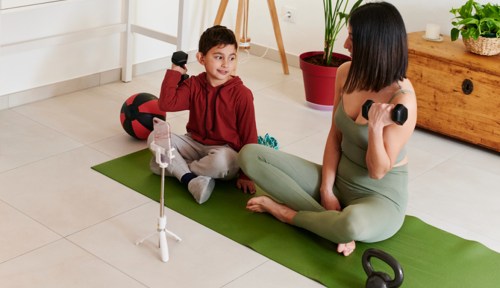
According to social learning theory, children largely acquire new behaviors through observation and imitation, explains Dr. Bostan.
That means caregivers arent doing their kids any favors by skipping their own self-care or daily movement routines.
How you talk about your daily dose of movement also plays into modeling fitness for your child.
Just be sure to lead with the feeling-forward values of exercise (rather than metrics).
For example, I love how free I feel when Im swimming in the pool.
But you dont need to run 26.2 miles to show your child the power of sport.
We take them to the local high school girls volleyball and basketball games whenever we can, says Brady.
And the latter outcome is what will ultimately support a healthy relationship with movement.
In reality, both groups will benefit from daily movement.
Ultimately those games result in a lot of movement, she points out.
Got a budding dancer at home?
It may be a one-and-done season.
It may be the beginning of a new passion.
Instead, encourage your child to participate in a wide array of appropriate activities both online and IRL.
Dont force it
Full stop: You cant make someone enjoy something.
All you might do is introduce your child to an activity and see how they respond.
I would encourage him to come for a walk with me, or throw a ball for the dog.
Any way to encourage movement without explicitly saying, you gotta move.
Neville, Ross D., et al.
9, Sept. 2022, pp.
886894, https://doi.org10.1001/jamapediatrics.2022.2313.
Sharma, Ashish et al.
Exercise for mental health.Primary care companion to the Journal of clinical psychiatryvol.
8,2 (2006): 106. doi:10.4088/pcc.v08n0208a
Hanke, Manuel et al.
Moderate-to-vigorous physical activity and reactivity to acute psychosocial stress in preadolescent children.Journal of science and medicine in sportvol.
26,9 (2023): 487-492. doi:10.1016/j.jsams.2023.07.010
Sutherland, Lisa A et al.
Like parent, like child: child food and beverage choices during role playing.Archives of pediatrics & adolescent medicinevol.
162,11 (2008): 1063-9. doi:10.1001/archpedi.162.11.1063
Lakicevic, Nemanja et al.
Make Fitness Fun: Could Novelty Be the Key Determinant for Physical Activity Adherence?.Frontiers in psychologyvol.
…
Got it, you’ve been added to our email list.
